

Supporting smallholders through strategic partnership for a more robust palm oil industry
Smallholders are a vital part of Indonesia’s palm oil sector. According to Indonesian National Plantation Statistics, they manage around 40% of the country’s total oil palm plantation area. For millions of households, palm oil is a key source of income that supports families and rural communities.
Asian Agri has partnered with smallholders since the 1980s, beginning with our involvement in the Transmigration Program (PIR-Trans). Over the years, this experience has shaped a partnership approach built on long-term collaboration and shared progress.
Since 2016, this commitment has been further strengthened through the One-to-One Partnership Commitment, which matches one hectare of company plantation with one hectare developed for smallholder farmers. It reflects a continued focus on growing together with the communities that are part of the supply chain.
As of 2025, Asian Agri works with more than 30,000 registered smallholders across Indonesia’s main palm oil–producing regions, covering more than 100,000 hectares of plantations.
Our Smallholder Partnership Models
Asian Agri partners with smallholders through two partnership models in North Sumatra, Riau, and Jambi, Indonesia.
Asian Agri supports both scheme and independent smallholders, with approaches tailored to each partnership model. The support focuses on practical, day-to-day plantation needs and is designed to reflect real field conditions.
Scheme Smallholders (Plasma)
Structured partnerships with long-term support
- Part of a formal partnership with Asian Agri
- Sell Fresh Fruit Bunches (FFB) directly to Asian Agri
- Manage plantations with ongoing technical guidance by Asian Agri
- Receive structured support, including training, access to superior planting materials, agronomic support, and reliable market access
Independent Smallholders
Operate independently, with optional engagement
- Manage plantations independently, without formal partnership arrangements
- Free to sell Fresh Fruit Bunches (FFB) to any mill or buyer, including Asian Agri
- Can engage with Asian Agri through training, practical field guidance, and sustainability awareness initiatives
- Support is non-structured and depends on level of engagement
How We Support Scheme and Independent Smallholders
Training and Capacity Building
Asian Agri supports both scheme and independent smallholders, with approaches tailored to each partnership model. The support focuses on practical, day-to-day plantation needs and is designed to reflect real field conditions.
Building practical skills is a core part of how smallholders improve their plantations.
- Scheme smallholders take part in structured and ongoing training programs embedded within the partnership. These cover best management practices (BMP), including harvesting, fertilizer application, workplace safety, and environmental management.
- Independent smallholders access training through initiatives such as SMILE (SMallholder Inclusion for Better Livelihood and Empowerment) and CSV (Corporate Shared Value). SMILE is a multi-stakeholder program that supports smallholders with training, certification (including RSPO), and productivity improvement. CSV focuses on inclusive partnerships that create shared economic and social value for communities.
In both cases, training is designed to be practical and applicable to real field conditions.
Economic Resilience and Market Access
Asian Agri supports both scheme and independent smallholders, with approaches tailored to each partnership model. The support focuses on practical, day-to-day plantation needs and is designed to reflect real field conditions.
Palm oil farming is a long-term cycle, and maintaining income stability is important, especially during replanting.
- Scheme smallholders benefit from structured support systems, including access to financing, assistance during replanting, and reliable market access through established supply arrangements.
- Independent smallholders are supported through initiatives that strengthen livelihoods, including cooperative development, and field-based programs such as Desa Sawit Lestari, which help farmers improve productivity and build more sustainable sources of income.
Through these efforts, smallholders are better able to manage income fluctuations and plan for the next productive phase.
Technical and Agronomic Support
Support in the field helps translate knowledge into improved plantation performance.
- Scheme smallholders work closely with field teams on an ongoing basis, with support integrated across the planting cycle. This includes access to high-quality planting materials, including Topaz seeds, regular agronomic guidance in the field, and coordinated support for replanting when trees reach the end of their productive life.
- Independent smallholders receive technical guidance through program-based engagement. This includes knowledge transfer, support in forming cooperatives, and improved access to inputs and tools that enhance farm management practices.
What Partnership Delivers
Over time, the partnership contributes to improved livelihoods and long-term well-being for smallholder families and their plantations.
Stronger Household Incomes
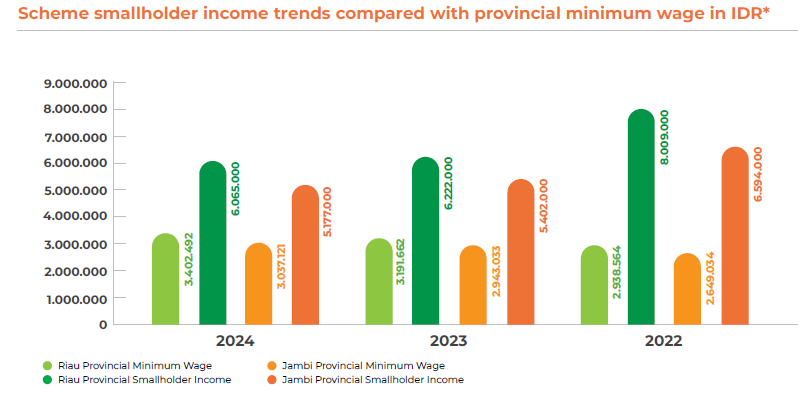
In 2024, smallholders participating in Riau recorded average gross incomes of around 1.8 times the provincial minimum wage. In Jambi, the figure was approximately 1.7 times.
Renewed and Productive Plantations
As palm trees age, yields naturally decline. Replanting helps restore productivity over the long term.
Since 2016:
- More than 18,900 hectares of smallholder plantations have been replanted
- 3,484 hectares were replanted in 2024
Greater Stability During Replanting
While new trees mature, income can slow. To help manage this transition, smallholders are supported in developing additional sources of income, including:
- Livestock
- Vegetable farming
- Small home-based businesses
This helps households maintain income while preparing for the next harvest cycle.
Strengthening Responsible Practices
Our partnerships are built for the long term. As plantation practices improve, sustainability becomes part of daily work.
Smallholders receive guidance related to the Indonesia Sustainable Palm Oil (ISPO) standard and the Roundtable on Sustainable Palm Oil (RSPO) certification. These standards support responsible plantation practices, including land management, proper record-keeping and good agricultural practices.
At the same time, this support contributes to Asian Agri’s AA2030 commitment to strengthen smallholder inclusion, including a target of enabling 5,000 independent smallholders to achieve RSPO certification through sustained capacity building and partnership programs.
Traceability is supported through plantation mapping and cooperative systems developed together with smallholder groups. This allows Fresh Fruit Bunches to be traced more clearly within the supply chain.
Through this approach, smallholders remain part of a responsible and transparent palm oil supply chain.
Working Alongside Smallholders
Partnership is not a one-time program. It is ongoing work in the field, built on trust and regular engagement.
Asian Agri stays close to smallholders through cooperatives and field teams, providing guidance, supporting market access, and responding to changing needs.
This long-term approach helps smallholders continue growing, improving, and preparing for the future.
Frequently Asked Questions (FAQs)
- What is Asian Agri’s smallholder partnership program?
Asian Agri’s smallholder partnership program is a structured, long-term collaboration with scheme (plasma) and independent smallholders in Indonesia. Asian Agri provides technical guidance, training on best management practices, access to planting materials, and market access for Fresh Fruit Bunches (FFB) to support responsible palm oil production and long-term plantation productivity. - How many smallholders does Asian Agri work with?
As of 2025, Asian Agri works with more than 30,000 registered smallholders across North Sumatra, Riau, and Jambi. The Company’s smallholder partnerships cover more than 100,000 hectares of oil palm plantations. - What is the difference between scheme and independent smallholders at Asian Agri?
Asian Agri’s scheme smallholders are part of government-initiated programs such as PIR-Trans and sell their harvest to Asian Agri under structured partnership arrangements. Asian Agri’s independent smallholders manage their plantations independently and may choose where to sell, while still receiving practical field guidance and technical support. - How does Asian Agri support smallholders during replanting?
Asian Agri supports smallholders during replanting by providing access to financing support, promoting alternative income activities, and maintaining market access for Fresh Fruit Bunches (FFB). Since 2015, Asian Agri has supported the replanting of more than 18,900 hectares of smallholder plantations to help restore long-term productivity. - How does Asian Agri support responsible and traceable palm oil production?
Asian Agri supports responsible and traceable palm oil production by guiding smallholders toward Indonesia Sustainable Palm Oil (ISPO) and Roundtable on Sustainable Palm Oil (RSPO) standards. Asian Agri strengthens traceability through plantation mapping and cooperative systems that allow Fresh Fruit Bunches (FFB) to be more clearly traced within the supply chain.