
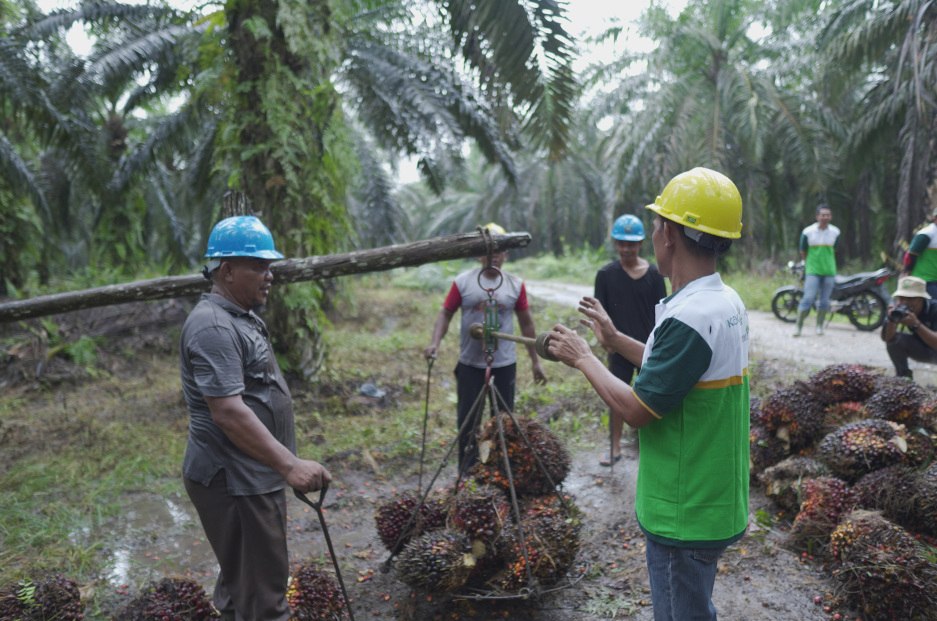
According to Ministry of Agriculture data cited by Roundtable on Sustainable Palm Oil (RSPO), independent smallholders contribute an estimated 35–40% of Indonesia’s fresh fruit bunch (FFB) production. Yet many still lack access to the technical guidance and resources needed to improve their plantations. Meeting sustainability standards and obtaining certification can also be difficult without proper support.
Better farming practices can help smallholders improve their harvests, manage costs, and earn more stable incomes. They can also open new opportunities in sustainable palm oil markets.
To help smallholders achieve these benefits, Asian Agri, Apical, and Kao Corporation launched the Smallholder Inclusion for Better Livelihood and Empowerment (SMILE) program in 2020. Through hands-on training and certification support, SMILE helps independent smallholders adopt sustainable practices and build stronger livelihoods.
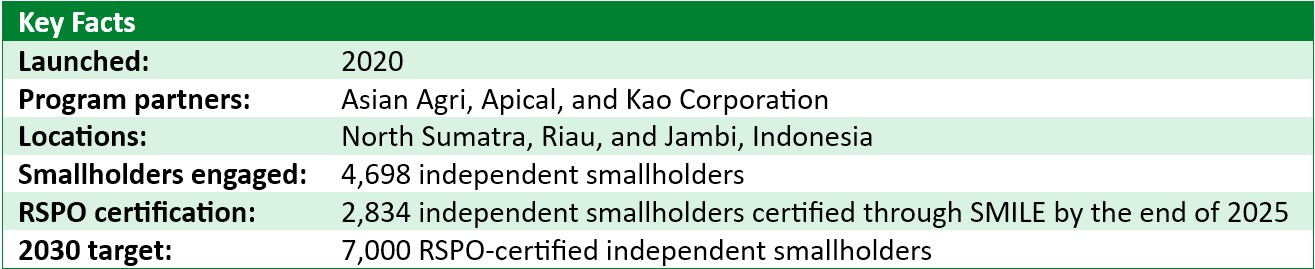 Progress figures are as of December 2025, based on Asian Agri’s reported SMILE data. The 2030 target reflects the updated program ambition.
What Is the SMILE Program and How Does It Support Independent Smallholders?
SMILE is a partnership that brings together three companies at different stages of the palm oil supply chain. Asian Agri works closely with farmers through its plantation operations, Apical processes the palm oil, while Kao purchases Roundtable on Sustainable Palm Oil (RSPO) Independent Smallholder Credits from certified SMILE smallholders. Their partnership connects support on the ground with opportunities further along the supply chain.
For Asian Agri, this work builds on its long partnership with smallholders. The company began working with plasma smallholders in 1987. It later expanded its support to independent smallholders through its Created Shared Value (CSV) program. Unlike plasma smallholders, independent smallholders manage their own plantations and choose where to sell their harvests.
Through SMILE, Asian Agri, Apical, and Kao work with local organizations and cooperatives in North Sumatra, Riau, and Jambi. Together, they provide practical guidance suited to smallholders’ needs.
Independent smallholders receive help with plantation mapping, recordkeeping, and preparations for RSPO certification. This allows them to work toward sustainability standards while retaining control of their plantations.
How Does SMILE Help Smallholders Improve Sustainable Farming Practices?
SMILE helps independent smallholders adopt better farming methods through Good Agricultural Practices (GAP) training and hands-on guidance. They learn how to care for their plantations, use resources wisely, and prepare for sustainability certification. The focus is on simple changes they can make in their daily work.
Through SMILE, smallholders receive practical training to improve how they manage their plantations, including how to:
- Apply fertilizers efficiently: Use the right amount to support healthy palm growth while reducing waste.
- Manage weeds effectively: Control weed growth while limiting unnecessary herbicide use.
- Maintain accurate records: Record plantation activities and organize documents needed for sustainability certification.
- Improve safety and environmental protection: Adopt safer working practices, prevent fires, and protect natural areas around their plantations.
By adopting these practices, smallholders can better manage their plantations and keep palms healthier. Over time, this can also lead to better harvests.
Khairul Anam, RSPO Group Manager of Koperasi Konsumen Tebing Tinggi Pangkatan Sejahtera (KKTTPS), has seen how these changes can benefit smallholders. KKTTPS achieved RSPO certification through SMILE in 2022.
“I have enjoyed several benefits that changed my life since I achieved RSPO certification through the SMILE Program,” said Khairul.
His experience shows how practical training and certification support can help smallholders manage their plantations more sustainably, although results may differ from one farm to another.
How Does RSPO Certification Through SMILE Benefit Smallholder Livelihoods?
RSPO certification can help independent smallholders reach markets that value sustainably produced palm oil. It also creates opportunities to earn premiums from certified palm oil. These payments can provide additional income for smallholders and help cooperatives invest in their development.
To access these benefits, smallholders must first meet RSPO standards. SMILE supports them by improving plantation records, tracing the origins of their harvests, and strengthening cooperative management. This guidance also helps farmers maintain their certification over time.
At Koperasi Konsumen Tebing Tinggi Pangkatan Sejahtera (KKTTPS) in North Sumatra, premiums earned through SMILE helped fund a new cooperative office in 2025. The office gives members a place to meet and manage their activities. Proceeds and premiums from certified palm oil have also supported the cooperative’s expansion, with membership growing from 239 to 773 farmers.
Other cooperatives have put their premiums to use on the plantations themselves. In Jambi, members of Perkumpulan Kotani Mandiri Bersama (PKMB) received premiums from Kao after achieving RSPO certification in 2023. They used the funds to buy fertilizers and other supplies for their farms.
By the end of 2025, 2,834 independent smallholders had achieved RSPO certification through SMILE. For smallholders like those at KKTTPS and PKMB, the benefits go beyond certification, as the premiums help them meet farming needs and invest in their cooperatives.
How Is SMILE Supporting the Future of Sustainable Palm Oil in Indonesia?
SMILE is helping more independent smallholders join Indonesia’s sustainable palm oil industry. Through training and cooperative support, farmers learn how to improve their plantations and meet the standards required by sustainable palm oil markets.
According to Asian Agri’s 2025 SMILE data, the program had reached 4,698 independent smallholders. This growing participation means more smallholders have opportunities to receive training and support in managing their plantations sustainably.
SMILE’s 2030 target is to have 7,000 independent smallholders RSPO-certified. While certification remains an important milestone, the long-term aim is to help smallholders maintain better practices, improve their livelihoods, and continue supplying sustainable palm oil.
Frequently Asked Questions (FAQs)
- What is Asian Agri’s SMILE program?
The Smallholder Inclusion for Better Livelihood and Empowerment (SMILE) program is a partnership between Asian Agri, Apical, and Kao Corporation. Launched in 2020, it helps independent oil palm smallholders in Indonesia improve plantation management, obtain RSPO certification, and access sustainable palm oil markets.
- How does SMILE help independent smallholders achieve RSPO certification?
Asian Agri and its SMILE partners help independent smallholders prepare for Roundtable on Sustainable Palm Oil (RSPO) certification through agricultural training, plantation mapping, farm recordkeeping, and cooperative support. Farmers also receive guidance to help them maintain certification and meet sustainability standards.
- What benefits do smallholders receive from RSPO certification through SMILE?
RSPO certification through SMILE gives independent smallholders opportunities to access sustainable palm oil markets and earn certification premiums. These payments can help farmers purchase agricultural supplies and improve cooperative facilities. By the end of 2025, 2,834 smallholders managing 6,574 hectares had achieved RSPO certification through SMILE.
- What is the difference between independent and plasma oil palm smallholders?
Independent smallholders manage their own oil palm plantations and can choose where to sell their harvests. Plasma smallholders are part of structured partnerships with plantation companies such as Asian Agri, which provide ongoing technical assistance, agricultural support, and access to markets.
- What is Kao Corporation’s role in the SMILE program?
Kao Corporation is SMILE’s downstream partner, working with Asian Agri and Apical to support independent oil palm smallholders. Kao purchases RSPO Independent Smallholder Credits from participating certified farmers, allowing them to earn premiums that can support their farming activities and livelihoods.
- Where is the SMILE program implemented in Indonesia?
The SMILE program operates in North Sumatra, Riau, and Jambi, Indonesia. Asian Agri, Apical, and Kao Corporation work with local organizations and smallholder cooperatives in these provinces to provide agricultural training, support plantation management, and help independent smallholders obtain RSPO certification.
- What is the SMILE program’s target for 2030?
The SMILE program aims to have 7,000 independent oil palm smallholders in Indonesia RSPO-certified by 2030.