
Key Takeaways:
- Tahuru ants are predatory ants from the Crematogaster genus that can support biological pest control in oil palm plantations.
- Asian Agri reduced the use of three targeted insecticides by 29.05% from its 2022 baseline by 2025, as it works toward a 50% reduction target by 2030.
- Biological controls can help protect oil palms while reducing unnecessary chemical treatment and improving how pest management is targeted in the field.
An oil palm tree relies on its broad canopy of leaves to keep growing and producing fruit. Bagworms and nettle caterpillars can steadily eat through that canopy, leaving the palm with less leaf surface to capture sunlight. If an infestation is not brought under control, the damage can weaken photosynthesis and eventually affect yields.
One of the natural allies that can support biological pest control is a small predatory ant from the Crematogaster genus, locally known as semut tahuru. In oil palm plantations, these ants can contribute to the natural regulation of pest populations by preying on insects found around the palm canopy.
Their use forms part of Asian Agri’s Integrated Pest Management approach, which combines field monitoring, natural predators, habitat management, and targeted intervention.
So, how can such a small insect contribute to protecting an entire plantation?
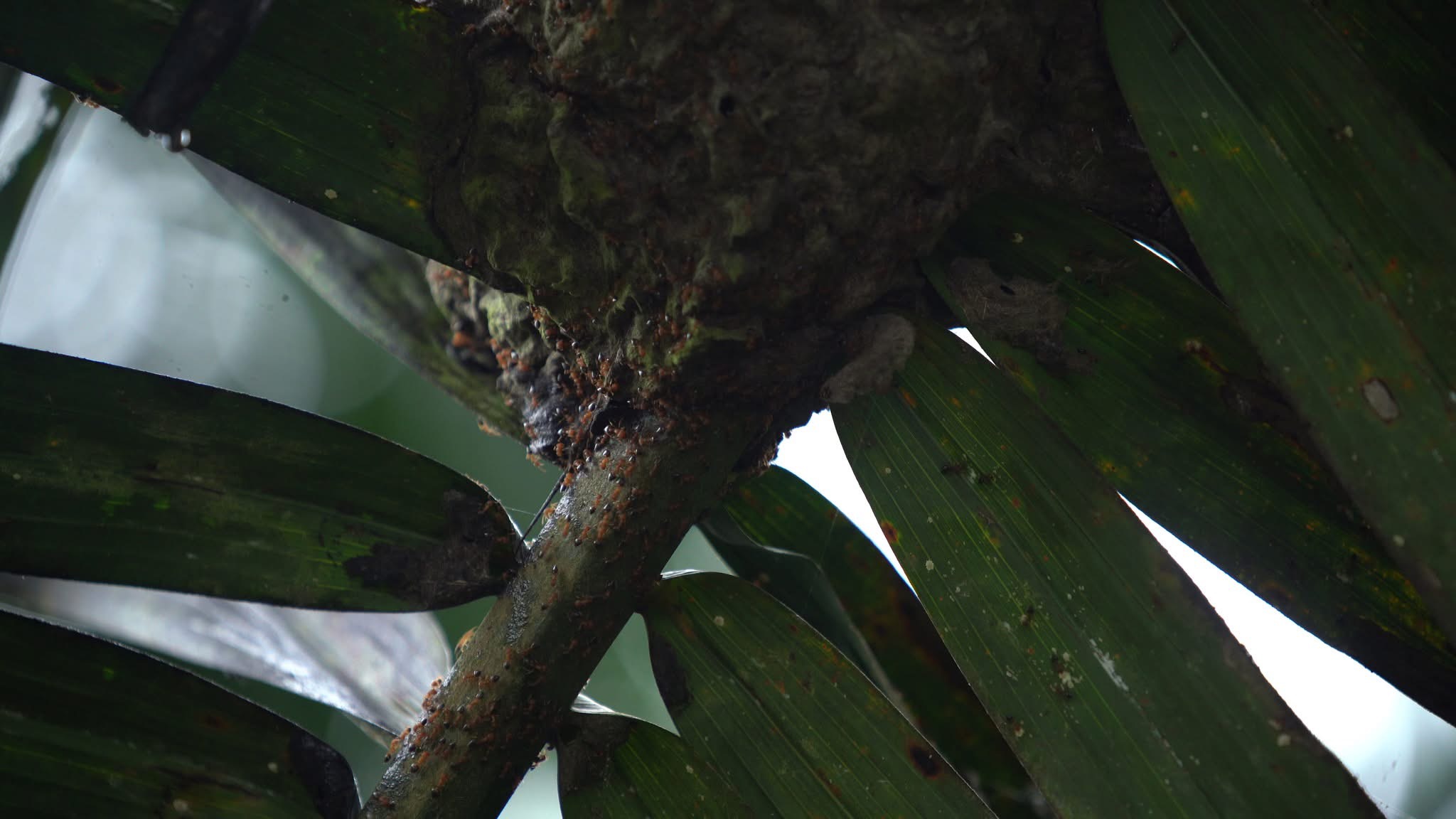
Tahuru ants moving along an oil palm frond as part of Asian Agri’s biological pest control approach
Why Natural Pest Control Matters in Oil Palm Plantations
Bagworms are difficult pests to deal with because they spend much of their life inside small cases made from silk and plant material. These cases move with them as they feed and offer some protection from predators and changing weather. By the time an infestation becomes easy to see, the population may already be well established.
Plantation teams need to know where pest numbers are rising and whether the damage is serious enough to require action. In some areas, natural predators may already be keeping populations under control, while others may require more targeted intervention. Chemical treatment remains an option, but an Integrated Pest Management approach prioritizes prevention, monitoring, and biological and ecological controls before targeted chemical intervention is considered.
Predatory ants are one option within this approach. A 2024 scientific review on ants as biological-control agents identified Crematogaster as one of the ant genera studied for its potential to control agricultural pests. Even so, ants need to be assessed carefully. Different species behave differently, and an ant that is useful in one setting may not have the same effect elsewhere.
As part of a broader pest-management approach, natural controls can help reduce the need for chemical treatment when pest levels are still manageable. Tahuru ants should also be monitored alongside other ant species and beneficial insects already present in the plantation, so their effect on the surrounding ecosystem can be properly assessed.
That same monitoring helps field teams identify where pest pressure is increasing and where action is actually needed. The goal is to match the response to conditions in the field and use each control method where it is most appropriate.
How Tahuru Ants Fit into Asian Agri’s Integrated Pest Management
At Asian Agri, pest control begins with what is happening in the field. Plantation teams monitor pest numbers, check the extent of leaf damage, and decide whether action is needed in a particular area. This means treatment is based on actual pest pressure, rather than applied across the plantation as a matter of routine.
Tahuru ants illustrate how natural predators can contribute to this approach. As predatory ants, members of the Crematogaster genus forage around vegetation and can prey on insects they encounter, making them potentially useful as part of biological pest-control systems.
Their role is not to replace other forms of pest management. Biological control works best as one part of a wider system that combines monitoring, habitat management, natural predators, traps, and selective chemical treatment when pest populations pass established thresholds.
Asian Agri also uses barn owls to control rats, nectar-bearing plants to support beneficial insects, parasitic wasps, predatory insects, and naturally occurring fungi.
Through ongoing field research and development, Asian Agri continues to strengthen pest and disease management and assess how biological controls can complement other methods used in the field.
Asian Agri’s 2025 Progress on Reducing Pesticide Use
Integrated Pest Management (IPM) is Asian Agri’s broader effort to reduce reliance on chemical pesticides. Through its AA2030 target, the company aims to reduce the use of three targeted insecticides by 50% from its 2022 baseline by 2030. Asian Agri’s 2025 Sustainability Report shows the progress made so far:
- Insecticide use decreased from 102,860 kilograms in 2022 to 72,981 kilograms in 2025.
- This represents a 29.05% reduction from the 2022 baseline.
- The target covers three insecticides used in pest management: deltamethrin, lambda-cyhalothrin, and acephate.
Why Biological Control Matters for Sustainable Palm Oil
Biological pest control can support more sustainable plantation management by using natural relationships within the ecosystem to help manage pest populations. When effective, it can reduce unnecessary chemical applications while helping plantation teams respond more precisely to pest pressure.
This is particularly important in oil palm, where pest management must work across large areas and over long production cycles. A combination of monitoring, habitat management, beneficial organisms, and targeted intervention can help maintain crop health without relying on a single control method.
For Asian Agri, these approaches form part of a wider effort to improve productivity while reducing environmental impacts. Biological controls such as predatory insects, parasitoids, beneficial plants, fungi, and barn owls demonstrate how plantation management can make greater use of ecological processes alongside conventional techniques.
The role of semut tahuru fits within this broader principle. Their significance is not that ants alone can solve pest problems, but that even small natural predators can contribute to a more integrated and targeted approach to protecting oil palms.
Frequently Asked Questions (FAQs)
What are tahuru ants?
Tahuru ants are small predatory ants from the Crematogaster genus. They can contribute to biological pest control by preying on insects and supporting the natural regulation of pest populations within plantation ecosystems.
How do tahuru ants protect oil palm trees?
Tahuru ants forage around vegetation and prey on insects they encounter. In an Integrated Pest Management system, predatory ants can complement other biological controls and help reduce reliance on unnecessary chemical treatment.
What are bagworms in oil palm plantations?
Bagworms are leaf-eating caterpillars that live inside protective cases made from silk and plant material. In oil palm plantations, large populations can damage leaves, reduce photosynthesis, and affect crop performance.
Does Asian Agri use ants instead of pesticides?
No. Biological controls are used as part of a broader Integrated Pest Management approach alongside regular field monitoring, habitat management, and targeted treatment. Chemical pesticides may still be used when pest populations rise above established control thresholds.
How does Integrated Pest Management reduce pesticide use?
Asian Agri’s Integrated Pest Management approach uses field monitoring, natural predators, habitat management, traps, and action thresholds. This helps teams apply chemical treatment only where and when it is needed.