
Ganoderma, a soil-borne fungus, is one of the most serious threats to oil palm plantations. It attacks the roots and causes basal stem rot, and the same fungus can also trigger upper stem rot as its spores spread. Once infected, the tree gradually weakens. In the early stages, the symptoms are barely noticeable, and by the time signs begin to show, the damage is often already extensive and yields start to drop.
A Reuters article published in 2025 highlights that Ganoderma is no longer a disease confined to older oil palm trees. In several Malaysian oil palm plantations, the fungus has been reported to appear much earlier in the planting cycle, including in replanted areas. This earlier onset increases the risk of yield losses from a younger plant age and may ultimately shorten the economic lifespan of plantations.
The challenge is compounded by the fact that, to date, there is no treatment or fungicide proven to effectively cure oil palm trees once they are infected. Scientific studies consistently show that the impact of Ganoderma is both severe and irreversible. Research documented by the US National Center for Biotechnology Information indicates that Ganoderma infections can reduce yields by as much as 80 percent and, in advanced cases, lead to the death of the tree.
Early detection, understanding how the disease spreads, and applying control strategies from the start are essential to keeping oil palms healthy and ensuring plantations remain productive.
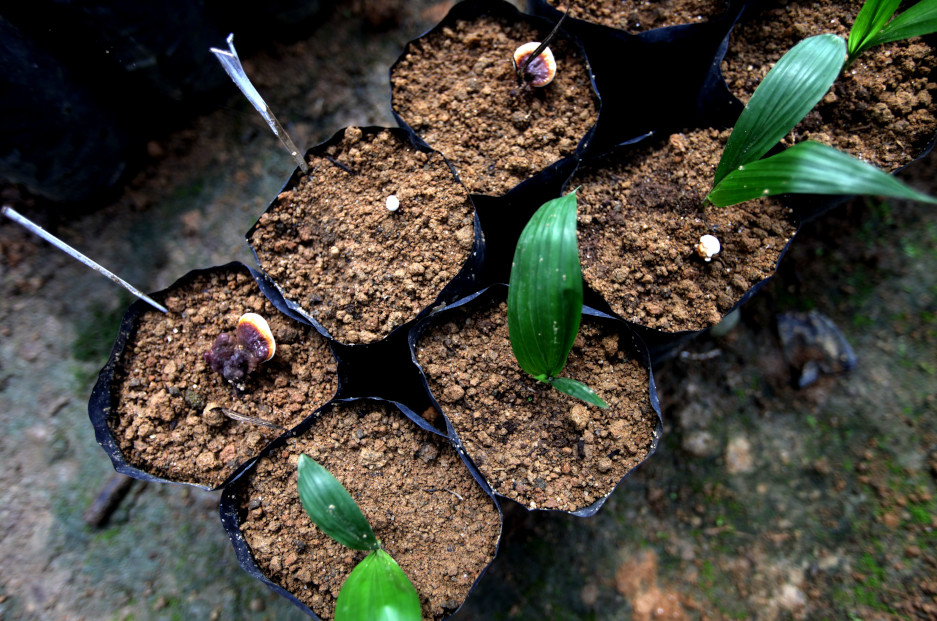
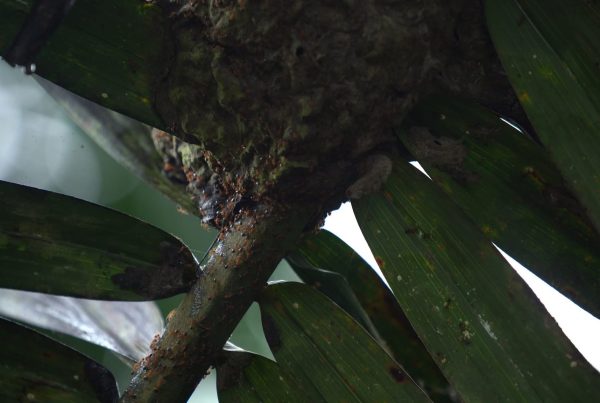
Ganoderma basidiocarps infecting oil palm seedlings
What is Ganoderma
Ganoderma is a soil fungus that can survive both as a decomposer and as a parasite. As a decomposer, it breaks down dead plant material, playing an important role in nutrient cycling. However, when acting as a parasite, Ganoderma can attack oil palm trees, causing basal stem rot or upper stem rot.
According to a study published in the American Journal of Applied Sciences, several Ganoderma species are capable of infecting oil palms:
- Ganoderma boninense – the most common and aggressive species, especially in Southeast Asia
- Ganoderma zonatum – typically found in the Americas, but can also infect oil palms
- Ganoderma miniatocinctum – less common, yet reported to cause basal stem rot in certain plantations
Stages of Ganoderma Infection in Oil Palm Trees
There are three stages of ganoderma infection symptoms, commonly used to determine whether a tree is infected and to assess the severity. Since the decay occurs within the trunk’s internal tissues, which are not visible from the outside, early detection is often challenging. The symptoms at each stage are as follows:
| STAGES | SYMPTOMS |
|---|---|
| Early Stage | ● Spear leaves fail to open and increase in number. ● Lower fronds begin to yellow or wilt. |
| Advanced Stage | ● Fungal fruiting bodies (basidiocarps) appear at the base of the trunk. ● Many fronds break and dry out. |
| Final Stage | ● The trunk collapses due to internal tissue decay. |
The end result of ganoderma infection is the death of the tree. To date, no fungicide has been found capable of curing infected trees. As a result, ganoderma significantly reduces the number of productive trees per hectare, directly lowering overall yields.
As the plantation matures, the risk of infection increases, which shortens its economic lifespan. Eventually, this drives the need to replant areas that have become unproductive.
Why is ganoderma management challenging
Beyond the concern over the death of palms infected with ganoderma, there is still no truly effective remedy to stop the decay process in the trunks of affected oil palms. The fungus lives in the soil, and the decomposition occurs inside the trunk, making it difficult to detect and control.
Various preventive measures have been attempted. These include removing infected palms and applying biological agents such as trichoderma or mycorrhiza to seedlings and planting pits. Fungicides are also injected into trees that are already infected.
All these measures require significant time, resources, and sustained effort. Even then, no single method has proven capable of eliminating ganoderma completely. For this reason, an integrated management approach that combines several complementary strategies offers a more realistic way to reduce infection levels in the field.
This approach focuses on early prevention by using tolerant planting material, supported by good field sanitation, proper management of infected palms, and regular monitoring of plantation conditions.
The challenge is further compounded by tropical growing conditions. The same warm and humid environment that supports oil palm growth also creates ideal conditions for ganoderma to thrive. Year-round rainfall and high overall precipitation keep moisture levels consistently high, allowing the fungus to spread more easily and making long-term control increasingly difficult.
Mitigating Ganoderma risks with Topaz GT seeds
Ganoderma-tolerant planting material plays a key role in integrated management and can greatly reduce the disease’s impact in the field. Choosing the right planting material also gives oil palm plantations a better chance of sustaining long-term productivity.
One example of ganoderma-tolerant planting material is the DxP Topaz variety. This variety is the result of decades of research and development at Asian Agri’s Oil Palm Research Station (OPRS).
“Since 1992, OPRS has been conducting selection and cross-testing between Deli dura and selected pisifera from Costa Rica. Between 1996 and 1998, we established the first Topaz seed garden and carried out DxP cross-testing using selected dura and pisifera from Costa Rica. These first-generation DxP tests showed promising yield and oil content potential. We didn’t stop there—we continued to carry out extensive and comprehensive second-generation DxP testing to develop an even more superior Topaz variety,” said Yopy Dedywiryanto, Head of Plant Breeding at Asian Agri.
Five superior DxP Topaz varieties have been successfully released:
- Topaz 1: Deli dura × Nigeria pisifera
- Topaz 2: Deli dura × Ghana pisifera
- Topaz 3: Deli dura × Ekona pisifera
- Topaz 4: Deli dura × Yangambi pisifera
- Topaz GT: A specific DxP Topaz cross that offers enhanced resistance to ganoderma
Topaz GT is the latest variety, specifically developed for higher resistance to stem rot disease caused by Ganoderma. Yopy added, “As part of our commitment to delivering the best for our customers, in 2019 OPRS released the DxP Topaz GT variety after testing infection using the most aggressive Ganoderma isolates available at Asian Agri. Using the most aggressive isolates provides greater assurance of Topaz GT’s resistance in areas with high Ganoderma infection levels.”
Even when tested with these aggressive Ganoderma isolates, nursery screening results still showed low infection rates. On average, the infection rate was around 45.7% (range 33.3–49.6%). This means that more than half of the seedlings tested were tolerant to ganoderma attacks.
In terms of production potential, Topaz GT recorded an average of 34.5 tons of fresh fruit bunches per hectare per year (from the third to the sixth year of production). Its crude palm oil potential reached 9.2 tons per hectare per year.
Advantages of Topaz GT
- Highly resistant to ganoderma infection
- High productivity in fresh fruit bunch (FFB) yield and oil extraction rate (OER)
- Ready for harvest 27 months after planting
- Slow height growth, making harvesting and maintenance easier
- Well adapted to marginal lands
Using Topaz GT seeds as part of an integrated management approach can significantly reduce ganoderma infections in the field while supporting the long-term sustainability of oil palm plantations. With regular monitoring, good sanitation, and a comprehensive control strategy, Topaz GT seeds help stabilize harvest yields and reduce maintenance costs.
Topaz GT is a proven, reliable solution for lowering ganoderma incidence in plantations. Visit the Topaz page to purchase superior Topaz seeds and get in touch with the Topaz team.
Frequently Asked Questions (FAQ)
- What is Ganoderma in palm oil plantations?
Ganoderma is a soil-borne fungus that is the main cause of basal stem rot in oil palm plantations. Ganoderma infection can significantly reduce yields and, in severe cases, lead to plant death within a short period. This fungus can also cause upper stem rot, which tends to spread more rapidly than basal stem rot.
- How does ganoderma spread in palm oil plantations?
Ganoderma fungi spread through the soil when plant roots come into contact with infected roots or contaminated soil. In warm and humid tropical conditions such as those in Indonesia, ganoderma also spreads through spores, which are easily produced and dispersed during periods of high rainfall.
- What are the early signs of Ganoderma infection?
The early signs of Ganoderma infection in oil palm include an increasing number of unopened spear leaves, as well as lower fronds that begin to yellow or wilt. At a more advanced stage, Ganoderma infection is characterized by the appearance of fungal fruiting bodies (basidiocarps) at the base of the trunk and by fronds that become dry or break easily.
- Apakah Ganoderma bisa diatasi setelah kelapa sawit terinfeksi?
To date, there is no treatment that can fully cure oil palm trees infected with Ganoderma. Chemical interventions, such as injecting fungicides into the trunk or applying soil fumigants, may temporarily slow the progression of the disease but cannot completely eradicate the fungus. As a result, disease management focuses on prevention, limiting its spread, and replanting using tolerant planting materials.
- What is Topaz GT, and how can this variety significantly reduce the percentage of ganoderma infection in the field?
Asian Agri’s DxP Topaz GT variety is a superior oil palm seed developed to have higher resistance to basal stem rot caused by ganoderma. This variety is tested using the most aggressive ganoderma isolates owned by Asian Agri, ensuring that only seeds with the strongest resistance pass the selection process. As a result, Topaz GT is able to reduce the percentage of ganoderma infection in the field and provide more stable resistance, particularly in areas with a high risk of infection.
- What are the advantages of the DxP Topaz GT variety?
The DxP Topaz GT variety developed by Asian Agri stands out for its high tolerance to ganoderma, with screening results indicating a relatively low infection rate of around 45.7 percent, even when tested using the most aggressive isolates. The variety also offers strong production potential, averaging 34.5 tonnes of fresh fruit bunches (FFB) per hectare per year and approximately 9.2 tonnes of crude palm oil (CPO) per hectare per year from the third to the sixth year. In addition, Topaz GT can be harvested earlier at 27 months, has slower height increment, and demonstrates good adaptability to marginal land conditions.
- Where can growers obtain more information or place orders for Topaz GT seeds?
Growers can learn more about Topaz GT and request consultations or place orders through the official Topaz product page.